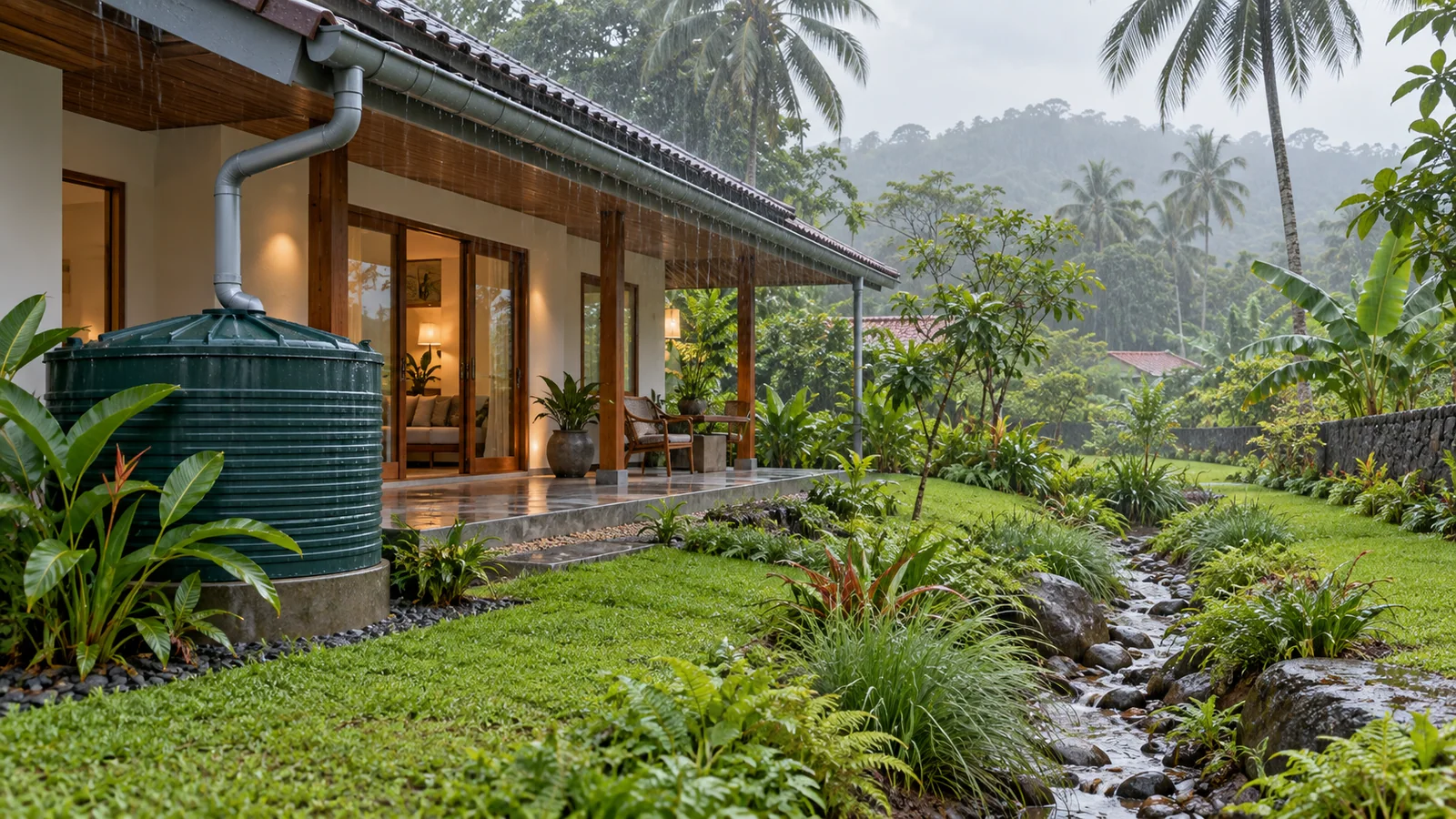
Hero image is an AI-generated illustrative concept, not a completed Structa project.
Short answer: A home rainwater-harvesting design should connect a suitable roof catchment to gutters, a first-flush arrangement, appropriate screening or treatment, storage and a safe overflow route. Decide what the water will be used for before selecting the system. Water intended for drinking needs appropriate treatment and quality assurance; a tank by itself does not make roof runoff potable. Coordinate the tank and overflow with the building structure, site levels, drainage and maintenance access.
Plan the whole rainwater path
Start on the roof plan. Identify which roof areas will drain to the system and where gutters and downpipes can be reached for cleaning. Coordinate them with solar panels, roof access, valleys and other services. Leaves, dust and bird droppings can enter roof runoff, so screening and a first-flush arrangement should be considered in the system design. The National Building Research Institute’s Sri Lanka rooftop rainwater-harvesting manual discusses design, construction and operation and is a useful technical reference for the design team.
Next, decide the intended use. Garden irrigation, cleaning and toilet flushing have different water-quality needs from drinking and cooking. Ask a qualified water professional what filtration, disinfection, testing and maintenance apply to your planned use. Keep the system’s labels, outlets and plumbing clear so non-potable water cannot be mistaken for treated drinking water.
Choose storage from demand and site constraints
Tank size is not selected from roof area alone. The design should consider local rainfall patterns, roof catchment, household demand, intended uses, periods between rain, available storage space, budget and overflow capacity. The NBRO page provides a manual and describes a Sri Lanka rainwater calculator; use such tools as planning aids and verify assumptions for your property.
Check the tank foundation and support before installation. A full tank is heavy. Confirm the base, access for delivery and replacement, distance from boundaries and foundations, and the route for overflow. Do not put a large tank on a roof or elevated platform unless a qualified structural professional has designed for the load.
Keep overflow and site drainage in the same plan
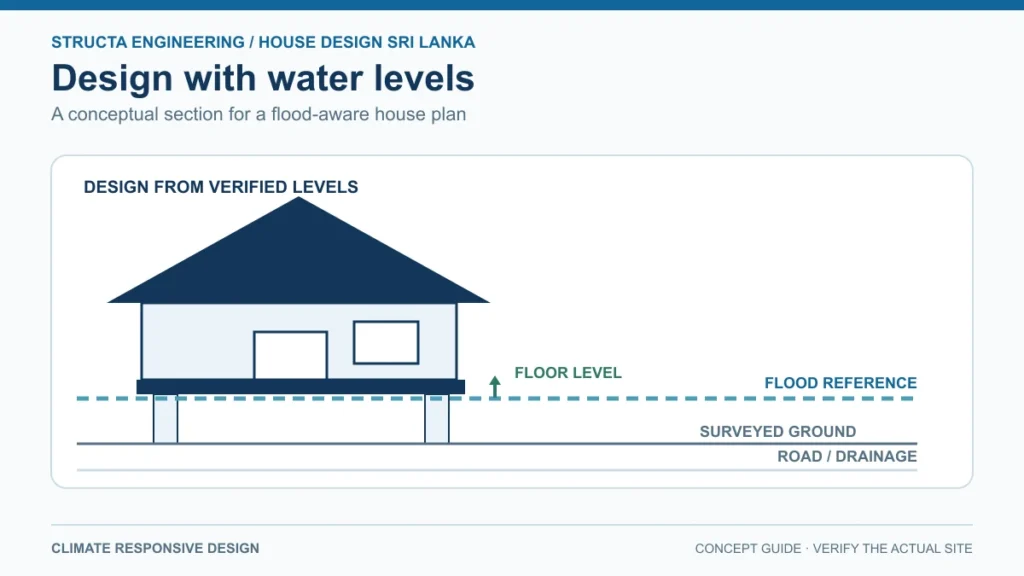
When a tank is full, water still needs a safe route. Show the overflow point and connect it to an approved drainage solution that does not erode the site, pond beside the house or discharge onto neighbouring land. Check what happens during intense rain when the ground and public drains are already wet. Roof-water management is not a replacement for a flood assessment on a flood-prone property.
Coordinate tank location and pipes with septic systems, wells, electrical equipment, vehicle routes and future extensions. Keep inspection points and filters accessible. Add a maintenance plan for cleaning gutters, screens, first-flush devices and tanks; a system that cannot be maintained may not perform as intended.
Planning checklist
- Intended water uses identified, including whether any use requires drinking-water quality
- Catchment roof areas and downpipes marked on the roof plan
- First-flush, screening and any treatment specified for the planned use
- Storage volume selected using a stated demand and rainfall basis
- Tank foundation and support reviewed for the full water load
- Overflow route coordinated with site levels and drainage
- Access provided for inspection, cleaning and replacement
- Current authority requirements checked for the property and building type
If the site is low-lying or has a known water issue, ask for a site-specific assessment. A rainwater tank alone cannot establish that a plot is flood-safe. Browse Structa’s guide library for related homeowner resources.
Frequently asked questions
Is collected rainwater safe to drink?
Not automatically. Roof runoff can contain contaminants. Drinking use requires a suitable treatment and water-quality approach, plus appropriate testing and maintenance.
Can I connect every downpipe to one tank?
Possibly, but the roof area, gutter capacity, pipe routes, tank inflow and overflow must be designed together. A professional should check the specific roof and rainfall assumptions.
Can rainwater harvesting prevent flooding on my land?
No single tank can guarantee that. It may capture some roof runoff, but site flooding depends on rainfall, ground levels, soil, watercourses, drains and wider catchment conditions. Design the complete drainage strategy.
Should a rainwater tank be installed before the house is designed?
It is better to reserve a suitable location and coordinate the loads, pipe routes and overflow during design, even if the tank is installed later.
Official reference
- National Building Research Institute, Design Manual for Rooftop Rainwater Harvesting Systems for Sri Lanka
- National Water Supply and Drainage Board, Rural water, sanitation and rainwater-harvesting resources
- Urban Development Authority, Planning and Development Regulations
This guide is general planning information and is not a water-quality certification, drainage design or approval. Confirm current standards and site-specific requirements with the relevant authority and qualified professionals.
Use this guide as general information
Site conditions, authority requirements and construction decisions vary by project. Confirm project-specific architectural and engineering matters with appropriately qualified professionals before relying on them for construction.